







Why Choose a Gas Generator for Global Power Needs?
Reliable electricity supports hospitals, factories, data centers, farms, and remote communities. Yet grid access remains uneven across many regions. A Gas Generator can provide dependable power where transmission lines are limited, damaged, or overloaded.
Energy historian Daniel Yergin once observed, “Energy is the lifeblood of society.” His statement explains the continuing value of practical generation equipment. Gas generators can start quickly, operate continuously, and support demanding loads. They may also produce fewer particulate emissions than diesel units when properly selected and maintained. Natural gas, biogas, and certain renewable gases can serve different operating conditions. Fuel availability still matters greatly.
Consider a rural clinic with vaccine refrigerators and surgical equipment. A well-sized generator can protect essential services during a long outage. In an industrial plant, several units can share loads and simplify maintenance planning. Remote operators can monitor fuel pressure, exhaust temperature, and engine vibration from a control room.
It is not a perfect answer. Gas supply can be interrupted. Methane leakage can weaken environmental benefits. Poor maintenance can increase emissions and shorten engine life. These risks deserve honest evaluation.
The strongest choice depends on local fuel networks, load patterns, climate, noise limits, and service capability. A professional assessment should compare lifecycle cost, emissions, redundancy, and future fuel options. Gas Generator technology offers flexibility, but responsible planning makes its value real.
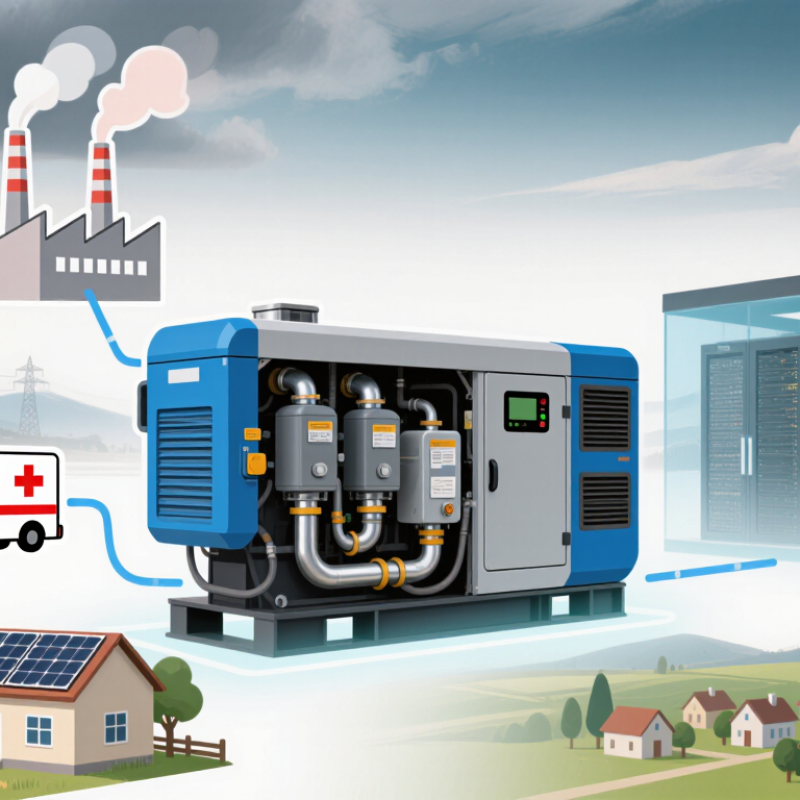
A gas generator converts fuel energy into electrical power through controlled combustion.
Gas enters the engine and mixes with air inside the cylinders. A spark ignites this mixture, creating pressure that moves the pistons. The crankshaft then turns an alternator, which produces electricity for connected equipment.
The process is simple, but the engineering is not. A controller regulates engine speed and monitors voltage, temperature, oil pressure, and frequency. When demand rises, the system adjusts fuel delivery to maintain stable output.
Natural gas can support continuous operation through a pipeline, while stored gas may serve remote or temporary sites. This flexibility makes gas generators useful for facilities, construction areas, and emergency backup power.
They are not silent. They are not maintenance-free. Combustion produces exhaust gases, so proper ventilation and approved installation are essential.
Local safety codes should guide fuel connections, clearances, grounding, and carbon monoxide protection. Technicians often inspect filters, spark plugs, coolant, belts, and battery condition before heavy use. These details are easy to overlook.
Gas generators can offer cleaner operation than many liquid-fuel alternatives, especially with efficient engines and dependable fuel quality. However, performance depends on altitude, ambient temperature, gas pressure, and load behavior.
A unit that looks powerful on paper may struggle with motor starting currents. Careful load calculations matter. In practice, selecting the right generator requires more than comparing rated kilowatts.
Gas generators offer practical advantages for power supply across different regions. They can operate on natural gas, biogas, or other approved gaseous fuels, depending on local infrastructure.
In many sites, gas burns more cleanly than diesel, producing lower particulate emissions and less visible smoke. This matters near hospitals, factories, and residential areas.
Fuel availability is another major benefit.
Where pipelines are reliable, gas generators can support long operating periods without frequent fuel deliveries. Technicians also value their stable performance during continuous-duty applications.
Modern control systems can adjust output to changing loads, helping reduce wasted fuel. However, this benefit depends on correct sizing. An oversized unit may run inefficiently.
Maintenance can be predictable.
Gas combustion often leaves fewer deposits on engine components than liquid-fuel systems. That may reduce certain service demands, though filters, ignition parts, oil, and cooling systems still require careful inspection.
Field experience shows that reliability depends on more than the generator itself. Gas pressure, fuel quality, ventilation, and spare-parts access all influence results.
Gas generators are not perfect.
Pipeline failures can stop production, and remote regions may lack dependable fuel networks. Biogas can also vary in composition, requiring additional treatment and testing.
Engineers should review local codes, emissions requirements, climate conditions, and the actual load profile before selecting equipment. A dependable system begins with honest site data, not optimistic assumptions.
Gas generators can provide steady electricity where grid reliability is uncertain. Their suitability depends heavily on fuel access, storage, and local infrastructure. Natural gas works well in cities with established pipeline networks. It usually requires less on-site storage than liquid fuels. However, pressure drops or pipeline interruptions can stop generation quickly.
Remote regions may rely on liquefied petroleum gas, compressed natural gas, or liquefied natural gas. LPG can support smaller facilities with cylinder banks or bulk tanks. CNG needs high-pressure storage and regular delivery planning. LNG offers greater energy density, but it requires insulated tanks and specialized handling. In colder climates, tank performance and vaporization equipment need careful attention. In tropical areas, heat exposure can increase storage pressure. These details are easy to underestimate.
Fuel quality matters too. Biogas can reduce waste and support local energy projects, but its moisture and contaminant levels require treatment. Infrastructure must include regulators, ventilation, leak detection, emergency shutoffs, and maintenance access. Local codes and trained technicians remain essential.
Tips: Confirm fuel availability during storms, transport delays, and seasonal demand. Test the generator under realistic loads. Keep backup fuel plans practical, not merely impressive on paper. A small site assessment can reveal hidden costs, such as weak roads, undersized pipes, or limited storage space. My own planning preference is conservative: reliability often depends on ordinary equipment details.
Why Choose a Gas Generator for Global Power Needs?
Environmental, Economic, and Operational Considerations
Gas generators can reduce emissions compared with coal-based generation, but they are not automatically clean. The IPCC reports median lifecycle emissions of about 490 grams of CO2-equivalent per kilowatt-hour for natural-gas generation, versus roughly 820 grams for coal. Methane leakage can weaken this advantage. The IEA’s Global Methane Tracker 2024 shows that fossil-fuel operations remain a major source of energy-related methane emissions. Fuel quality and pipeline maintenance matter.
Economically, gas generation offers useful flexibility. IEA Electricity 2024 identifies gas plants as important balancing resources when wind and solar output changes quickly. A modular generator can support a hospital, mine, or remote workshop without waiting for grid expansion. Yet fuel prices can shift sharply. Transport, storage, servicing, and standby losses also affect the real cost. A low purchase price may hide expensive operation.
Operationally, gas units often start quickly and provide stable voltage for sensitive equipment. Modern systems can reach electrical efficiencies above 40 percent, depending on size and configuration. Operators still need ventilation, leak detection, scheduled inspections, and trained personnel. Small mistakes become costly. A generator may run smoothly for months, then fail during peak demand because maintenance was postponed. That uncomfortable risk deserves more attention. Each project should compare local fuel access, emissions controls, backup requirements, and total lifetime cost, not only rated output.
| Dimension | Metric or Consideration | Gas Generator Profile | Practical Implication | Data Basis and Important Conditions |
|---|---|---|---|---|
| Environmental | Direct carbon dioxide emissions | Approximately 0.40–0.55 kg CO₂/kWh of electricity generated when natural gas is used at about 35–45% electrical efficiency. | Typically lower direct CO₂ emissions than liquid-fuel generators for the same electrical output. | Calculated from the natural-gas combustion factor of approximately 53.06 kg CO₂/MMBtu. Actual results depend on generator efficiency and load. |
| Environmental | Comparison with diesel fuel | Diesel generation commonly produces approximately 0.60–0.75 kg CO₂/kWh at similar efficiency levels. | Gas can reduce direct CO₂ emissions by roughly 20–35% compared with diesel, before upstream methane emissions are considered. | Diesel comparison uses an approximate combustion factor of 74.14 kg CO₂/MMBtu. Site-specific fuel consumption should be used for final calculations. |
| Environmental | Local air pollutants | Lean-burn gas engines generally produce lower particulate matter and sulfur oxide emissions because natural gas contains very little sulfur and produces no fuel ash. | May support compliance with urban air-quality requirements and reduce visible exhaust emissions. | Carbon monoxide, nitrogen oxides, and unburned methane vary significantly by engine design, emissions controls, operating temperature, and load. |
| Environmental | Upstream methane impact | Natural gas supply chains can create methane emissions during production, processing, transmission, storage, and distribution. | The climate advantage of gas is strongest when methane leakage is controlled and measured across the supply chain. | Methane has a much higher short-term global-warming impact than CO₂. Lifecycle assessments should use regional leakage data rather than combustion emissions alone. |
| Economic | Fuel-cost calculation | Approximate fuel cost per kWh = gas price per MMBtu ÷ (293.07 × electrical efficiency). | At 40% efficiency, each MMBtu of gas produces about 117 kWh of electricity before auxiliary consumption. | 293.07 kWh is the thermal-energy equivalent of 1 MMBtu. The actual cost depends on contract terms, transport charges, taxes, and local gas prices. |
| Economic | Fuel-price exposure | Operating cost is linked to pipeline gas, compressed natural gas, or liquefied natural gas prices, depending on the site. | Gas can be economically attractive where fuel infrastructure is reliable and competitively priced, but price volatility should be modeled. | Long-term contracts, storage capacity, transport fees, and seasonal demand can materially change the delivered fuel price. |
| Economic | Capital and infrastructure requirements | May require a gas connection, pressure-regulation equipment, metering, ventilation, safety systems, or on-site CNG/LNG storage. | Higher installation complexity than a simple liquid-fuel backup system may be offset by reduced on-site fuel handling. | Costs depend on distance to the gas network, required pressure, permitting, site conditions, storage design, and local safety codes. |
| Operational | Electrical efficiency | Typical reciprocating gas-generator electrical efficiency is approximately 30–45%, depending on unit size, technology, and load. | Higher efficiency reduces fuel consumption and operating emissions per kWh. | Efficiency is normally highest near the design load. Part-load operation can increase fuel consumption per unit of electricity. |
| Operational | Reliability of fuel supply | Pipeline gas can provide continuous fuel delivery, while CNG and LNG systems depend on storage and resupply logistics. | Useful for extended operation when the gas network is resilient; a backup fuel or storage strategy may still be required for critical loads. | Earthquakes, extreme weather, pipeline damage, pressure loss, curtailment, and utility outages can interrupt gas availability. |
| Operational | Start-up and load response | Modern gas generator sets can provide rapid standby response, but start time varies by engine, controls, synchronization equipment, and local requirements. | Suitable for standby, peak shaving, microgrids, and distributed generation when properly integrated with automatic transfer and control systems. | Actual performance should be verified using the manufacturer-neutral project specification, including cold-start time, ramp rate, minimum load, and transient response. |
| Operational | Maintenance requirements | Requires scheduled inspections, oil and filter service, spark-plug or ignition-system maintenance, valve checks, cooling-system service, and emissions-system checks. | Maintenance planning is essential for dependable operation, particularly in continuous-duty and high-load applications. | Service intervals vary by engine design, gas quality, duty cycle, lubricant, ambient conditions, and operating hours. Follow the certified maintenance schedule. |
| Operational | Combined heat and power potential | Waste heat from the exhaust and engine cooling system can be recovered for hot water, steam, heating, or industrial processes. | Total system efficiency can reach approximately 70–90% when recovered heat is consistently used. | High total efficiency is achievable only when there is a suitable and continuous thermal load. Heat-recovery equipment adds capital and maintenance requirements. |
| Global Deployment | Fuel availability and portability | Most practical where pipeline gas, CNG, or LNG infrastructure is available; remote locations may require modular storage and regular deliveries. | Gas generators are well suited to gas-rich regions, industrial facilities, utilities, and resilient microgrids, but less suitable where fuel logistics are uncertain. | Project evaluation should include local gas composition, supply pressure, transportation access, import dependence, emergency fuel storage, and applicable regulations. |
| Global Deployment | Safety and compliance | Requires gas detection, emergency shutoff, ventilation, pressure control, fire protection, electrical bonding, and adherence to local installation codes. | Proper design and commissioning are necessary to manage fire, explosion, pressure, and confined-space risks. | Requirements differ by jurisdiction. Engineering reviews should reference applicable national and local gas, electrical, fire, environmental, and pressure-vessel standards. |
| Note: Values are engineering ranges intended for preliminary comparison. Final selection should use certified generator data, site-specific fuel prices, local emissions requirements, measured gas quality, expected load profile, and a lifecycle cost assessment. | ||||
Selecting the right gas generator starts with the application, not the advertised output. A small office may need stable power for computers, lighting, and cooling. A construction site may require high starting power for pumps and compressors. Hospitals and data facilities demand rapid transfer, redundancy, and careful voltage control. The load profile matters more than the nameplate rating.
Measure continuous demand and motor-starting surges separately. Leave practical capacity for future equipment, but avoid excessive oversizing. An oversized generator can operate inefficiently at light loads. Fuel availability also shapes the decision. Natural gas suits fixed installations with dependable pipelines. Liquefied petroleum gas can support remote or backup locations, provided storage and delivery are reliable. Local climate, altitude, ventilation, and noise limits must be checked before purchase.
Control systems should match the site’s risk level. Automatic transfer equipment is useful where interruptions cannot be tolerated. Remote monitoring can reveal low pressure, overheating, or overdue service before failure occurs. Maintenance access is easy to overlook. It should not be. Filters, spark plugs, batteries, and exhaust components need safe, regular inspection. Field teams often discover that installation quality affects reliability as much as generator size. No selection is perfect. A careful load study, verified by a qualified technician, can expose assumptions that look reasonable on paper but fail during real operation.
No, I will think about it in future.


