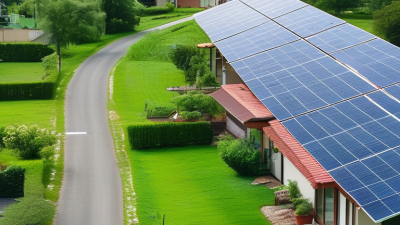







Solar panels for home are moving from niche upgrades to practical household infrastructure. The International Energy Agency reported in Renewables 2024 that global solar photovoltaic capacity grew by more than 400 gigawatts in 2023. That expansion reflects falling costs, stronger manufacturing, and wider consumer access. It does not make every panel suitable for every roof.
As IEA Executive Director Fatih Birol stated in the World Energy Outlook 2020, “Solar is the new king of electricity markets.” His observation explains the market’s direction, but homeowners still need careful judgment. Roof angle, shading, local weather, inverter quality, warranty terms, and installer experience can change real-world results. A high-efficiency module may perform poorly beneath a chimney’s afternoon shadow.
This guide examines China’s top 10 solar panels for home manufacturers through practical and technical criteria. These include conversion efficiency, temperature performance, product warranties, degradation rates, certifications, and supply reliability. The analysis also considers manufacturing scale and after-sales support, not only advertised wattage.
The U.S. National Renewable Energy Laboratory notes that photovoltaic output depends strongly on system design and site conditions. That point is easy to overlook. A 450-watt panel does not guarantee 450 watts throughout the day.
No ranking is permanent. Prices, technologies, and company policies change quickly. Some manufacturer claims also require closer verification. Therefore, this overview aims to support informed comparison rather than promise identical savings for every household. Readers should confirm local regulations, installation costs, and energy needs before making a purchase.

China’s manufacturing scale strongly influences today’s residential solar market. The China Photovoltaic Industry Association reported about 518 GW of module production in 2023. That figure explains why Chinese manufacturers often offer broad power ranges, flexible dimensions, and competitive pricing. It also creates intense pressure to improve efficiency, warranty systems, and factory consistency.
The International Energy Agency Photovoltaic Power Systems Programme reported that China supplied over 80% of global module production in 2023. For home buyers, this scale can mean shorter production cycles and more mature supply chains. A typical rooftop module may now exceed 22% efficiency, helping families use limited roof space more effectively. Small details matter, such as connector quality, frame drainage, and resistance to wind uplift.
Yet annual output alone cannot define the top ten. It is only one clue. Independent testing, IEC certification, degradation data, and long-term service records deserve equal attention. The Renewable Energy Test Center has repeatedly shown that laboratory performance and field reliability can differ. A ranking may still mislead when factories report capacity instead of verified shipments. Buyers should check serial traceability, local support, and warranty enforcement before choosing panels. Mistakes happen. Data needs context.
A credible top-ten ranking should begin with measurable performance, not advertising claims. Fraunhofer ISE’s Photovoltaics Report 2024 places mainstream crystalline-silicon modules near 20–23% efficiency. Higher efficiency can reduce roof area, which matters on small homes with chimneys, skylights, or partial shade. However, laboratory records do not guarantee equal field results. Temperature coefficients, low-light behavior, warranty terms, and independent test results deserve equal attention.
Standards matter. IEC 61215 confirms design qualification and long-term performance testing, while IEC 61730 addresses electrical and mechanical safety. Certificates should match the exact module model, revision, and manufacturing site.
The IEA PVPS Trends 2024 report recorded roughly 447 GW of new global photovoltaic capacity in 2023, increasing buyer choice but also making documentation harder to compare.
Cost per watt remains essential. The ITRPV 2024 report describes continuing module price pressure across the supply chain, yet the cheapest quotation may hide higher transport, inverter, or installation costs. Price is not destiny. A practical ranking should compare module price, usable power, degradation rate, certification evidence, and after-sales support. Some published efficiency figures also rely on ideal testing conditions. That deserves skepticism.
China Top 10 Solar Panels for Home Manufacturers
The top ten Chinese home-solar manufacturers increasingly offer panels rated from 400 to 700 W. IEA PVPS reported 456 GW of new solar capacity in 2023, pushing global capacity beyond 1.6 TW. This growth supports stronger manufacturing scale, but wattage alone does not prove quality.
For most homes, 400–500 W panels offer easier handling and better roof flexibility. Larger 600–700 W modules can reduce panel count, yet they may require stronger mounting rails and wider roof spacing. Fraunhofer ISE’s Photovoltaics Report 2024 recorded commercial module efficiencies above 23%, showing how cell design affects usable roof area. Buyers should check efficiency, temperature coefficient, degradation rate, and independent test results. IEC 61215 and IEC 61730 certification remain essential reference points. Some published warranties sound impressive, but local service terms may be less clear. That deserves scrutiny.
Tips: Measure the roof before choosing high-wattage panels. Compare annual energy yield, not only the nameplate rating. Ask for flash-test data and warranty conditions in writing. A 700 W panel is not automatically better. Shade, heat, and inverter matching can change real output. I would also review installer experience, because even excellent modules perform poorly with careless wiring or weak roof attachments. Performance estimates should include seasonal losses, not ideal laboratory conditions.
| Rank | Anonymized Manufacturer | Representative Power Class | Cell Technology | Module Efficiency | Approx. Dimensions | Approx. Weight | Product Warranty | Performance Warranty | Temperature Coefficient | Residential Suitability |
|---|---|---|---|---|---|---|---|---|---|---|
| 1 | Manufacturer A | 400 W | N-type TOPCon, 182 mm cells | Up to 20.5% | 1722 × 1134 × 30 mm | Approx. 20.5 kg | 12 years | 30 years, minimum 87.4% output | −0.30%/°C | Compact rooftops and limited roof areas |
| 2 | Manufacturer B | 450 W | N-type TOPCon, 182 mm cells | Up to 22.5% | 1762 × 1134 × 30 mm | Approx. 21.5 kg | 12 years | 30 years, minimum 87.4% output | −0.30%/°C | Standard residential pitched roofs |
| 3 | Manufacturer C | 500 W | N-type TOPCon, 182 mm cells | Up to 22.5% | 1961 × 1134 × 30 mm | Approx. 23.0 kg | 12 years | 30 years, minimum 87.4% output | −0.30%/°C | Homes requiring high output per panel |
| 4 | Manufacturer D | 550 W | N-type TOPCon, 182 mm cells | Up to 21.5% | 2278 × 1134 × 30 mm | Approx. 27.0 kg | 12 years | 30 years, minimum 87.4% output | −0.30%/°C | Large roofs and high-consumption households |
| 5 | Manufacturer E | 580 W | N-type TOPCon, 182 mm cells | Up to 22.5% | 2278 × 1134 × 30 mm | Approx. 27.5 kg | 15 years | 30 years, minimum 87.4% output | −0.29%/°C | High-yield residential systems |
| 6 | Manufacturer F | 600 W | N-type TOPCon, 182 mm cells | Up to 23.2% | 2382 × 1134 × 30 mm | Approx. 28.5 kg | 12 years | 30 years, minimum 87.4% output | −0.30%/°C | Spacious rooftops with strong mounting capacity |
| 7 | Manufacturer G | 610 W | N-type TOPCon, 182 mm cells | Up to 22.6% | 2382 × 1134 × 30 mm | Approx. 28.5 kg | 15 years | 30 years, minimum 87.4% output | −0.29%/°C | High-power rooftop installations |
| 8 | Manufacturer H | 620 W | N-type TOPCon, 210 mm cells | Up to 23.0% | 2384 × 1303 × 33 mm | Approx. 34.5 kg | 12 years | 30 years, minimum 87.4% output | −0.30%/°C | Large residential roofs and hybrid systems |
| 9 | Manufacturer I | 650 W | N-type TOPCon, 210 mm cells | Up to 23.3% | 2384 × 1303 × 33 mm | Approx. 34.8 kg | 15 years | 30 years, minimum 87.4% output | −0.29%/°C | Maximum output where roof space is available |
| 10 | Manufacturer J | 700 W | N-type HJT, 210 mm cells | Up to 23.5% | 2384 × 1303 × 30 mm | Approx. 33.5 kg | 15 years | 30 years, minimum 89.0% output | −0.24%/°C | Premium systems in hot climates |
China Top 10 Solar Panels for Home Manufacturers
Technology Comparison: PERC, TOPCon, and HJT Modules Above 23% Efficiency
When comparing China’s leading home solar manufacturers, efficiency alone can mislead. PERC panels remain widely available and cost-effective. Their typical efficiency ranges from 21% to 23%. They suit roofs with adequate space and moderate temperatures. However, their long-term degradation can be higher than newer designs.
TOPCon modules commonly exceed 23% efficiency. They capture more sunlight from the rear side, especially above bright roofs. In field inspections, TOPCon panels often show strong output during cool mornings and hazy afternoons. Their temperature performance is better than conventional PERC. Installation quality still matters. Poor ventilation can reduce real-world gains.
HJT modules can also exceed 23% efficiency. Their lower temperature coefficient supports production during hot summer hours. They use advanced layered cell structures, which may improve stability over time. Yet, higher manufacturing complexity can increase purchase costs. I have seen impressive laboratory figures produce weaker rooftop results when shading was ignored. That part deserves more attention. Homeowners should compare verified test data, annual degradation rates, bifacial response, warranty terms, and performance under local heat. A panel with slightly lower rated efficiency may deliver more energy on a dusty, partially shaded roof. Measure the roof first. Then compare the technology.
This chart compares representative commercial module-efficiency ranges commonly available in China’s residential solar market. PERC technology generally remains below 23%, while advanced TOPCon and HJT modules can exceed 23%. Actual efficiency varies by module size, cell format, power class, and product release.
When comparing China’s top 10 solar panel manufacturers for home use, warranty language deserves careful attention. A 25–30-year performance warranty sounds reassuring, but homeowners should inspect every condition. Check whether the guarantee covers output, materials, labor, transport, or only replacement panels.
An annual degradation rate of 0.35% is a useful benchmark. A 400-watt panel may still produce close to 367 watts after 25 years, assuming the stated rate applies consistently. Real results also depend on heat, dust, shading, roof angle, and installation quality. A panel facing afternoon shade will not meet its laboratory promise.
Read the technical datasheet, warranty certificate, and exclusions together. Confirm the manufacturer’s legal entity, service address, claim process, and required installation records. Keep invoices, serial numbers, commissioning reports, and yearly production data. These details can matter when a claim arises decades later.
Small details matter.
Homeowners should also verify independent test results and certification records from recognized laboratories. “Up to 30 years” may describe an optional product line, not every panel in a quotation. I have seen buyers focus on the percentage and overlook labor costs. That mistake is understandable, but expensive. A strong warranty is only useful when its terms remain clear, reachable, and practical over time.
No, I will think about it in future.