China Best Square Tube Manufacturer for Global Buyers?
Choosing the China best Square Tube manufacturer for global buyers requires more than comparing prices. A reliable supplier should demonstrate consistent quality, technical experience, and clear production control. Square Tube products may look similar in online catalogs, yet differences appear in wall thickness, corner radius, surface finish, and dimensional accuracy. These details can affect welding, coating, structural performance, and installation time.
Experienced buyers usually examine the entire supply process. This includes raw material certificates, forming equipment, heat treatment records, and factory inspection procedures. A dependable manufacturer should provide traceable batch information and practical testing data. Common checks include chemical composition, tensile strength, elongation, dimensions, and coating thickness. Samples matter. A polished sample does not always represent normal production.
Real projects also require flexible support. A capable Chinese supplier may offer carbon steel, galvanized, stainless steel, or customized Square Tube options. It should understand international packaging, container loading, export documentation, and delivery planning. Photos of bundles, protective caps, and moisture-resistant wrapping can reveal useful details before shipment. Small details matter.
No single manufacturer is best for every buyer. One factory may provide excellent customization but longer lead times. Another may offer competitive pricing but limited inspection support. This is where careful evaluation becomes essential. Factory audits, third-party testing, reference projects, and direct technical communication can reduce uncertainty. The strongest choice is not always the cheapest one. It is the supplier that combines dependable quality, honest communication, and repeatable performance over time. Mistakes still happen, so transparent correction procedures deserve attention.
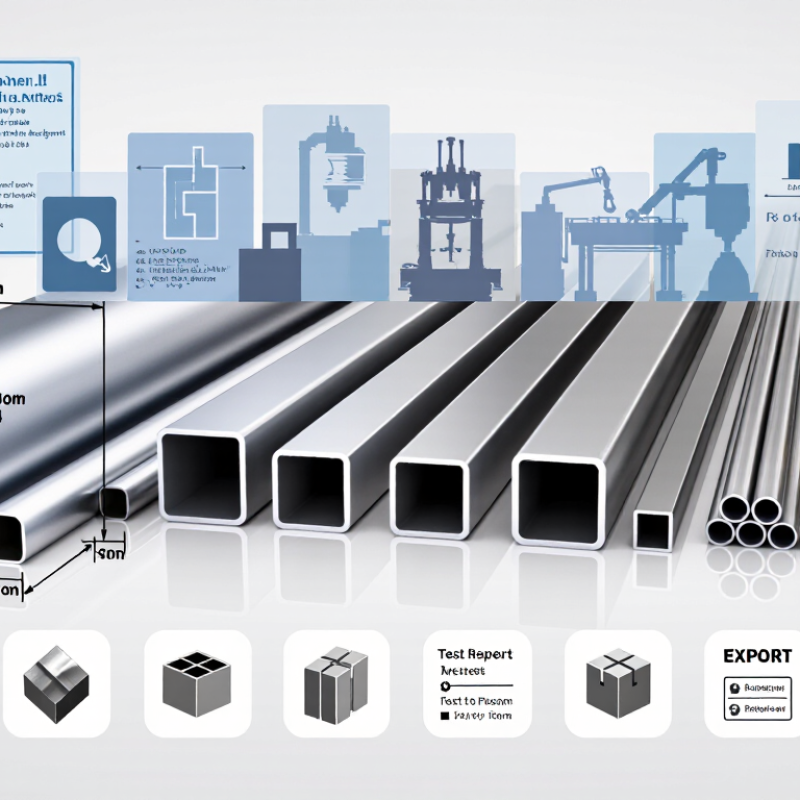
What Is a Square Tube and Why Does Its Manufacturer Matter?
A square tube is a hollow steel section with four flat sides and a uniform wall. Its shape provides efficient strength for frames, columns, gates, machinery, and solar structures. Unlike solid bar, it reduces weight while keeping useful bending resistance. That simple geometry can hide difficult production decisions.
The manufacturer matters because dimensions alone do not prove performance. A reliable mill controls steel chemistry, welding, corner radius, wall thickness, straightness, and surface quality. ASTM A500, commonly used for structural tubing, specifies requirements for composition, tensile strength, yield strength, and dimensional tolerances. Buyers should request mill test certificates, heat numbers, inspection records, and clear coating details. Traceability is not paperwork decoration. It connects one bundle of tubes to its actual steel batch.
Scale also matters. The World Steel Association reported about 1,892 million tonnes of crude steel production in 2023. Such volume does not guarantee consistent tube quality. The International Energy Agency estimates that iron and steel production creates roughly 2.6 gigatonnes of direct CO2 emissions annually, or about 7–9% of global energy-related emissions. A capable manufacturer can reduce waste through accurate cutting, stable forming, and recyclable packaging. I have seen low prices look attractive, then become expensive after rework. Specifications are only useful when production follows them. That is the uncomfortable part.
What Is a Square Tube and Why Does Its Manufacturer Matter?
A square tube is a hollow structural section with four equal sides, commonly used in construction, machinery, transportation, and general fabrication. The chart shows the theoretical mass per metre for common square tube sizes, calculated using a steel density of approximately 7,850 kg/m³.
For global buyers, manufacturer selection matters because dimensional tolerances, steel grade consistency, weld quality, surface treatment, testing, and certification directly affect structural performance, logistics cost, and project compliance.
How to Evaluate a Square Tube Manufacturer in China
How to Evaluate a Square Tube Manufacturer in China
Choosing a square tube manufacturer requires more than comparing prices. China produced about 1.005 billion tonnes of crude steel in 2024, according to World Steel Association data. Large output does not guarantee consistent tube quality. Ask for mill certificates, heat numbers, and inspection records for every production batch. Check whether the certificate matches the steel grade, wall thickness, and delivery lot. Numbers matter.
A practical audit should examine the slitting line, forming stands, welding area, and storage yard. Measure sample tubes with calibrated tools, especially corner radius, outside dimensions, wall thickness, and straightness. Request tests for tensile strength, yield strength, elongation, and weld integrity when the project requires them. ISO’s Survey of Certifications reported more than 1.26 million ISO 9001 certificates worldwide in 2022. Certification supports process control, but it does not replace physical inspection.
Evaluate traceability from coil receipt to final packing. Photograph bundle labels and compare them with the packing list. Confirm production capacity using recent shipment records, not impressive machinery alone. A pre-shipment inspection can reveal oval corners, rough weld beads, or coating damage. Audit the process. Also review export experience, packaging strength, complaint handling, and corrective-action records. One weakness deserves attention: suppliers may present their best samples during an audit. Independent sampling remains wiser, particularly for long-term contracts and safety-critical structures.
Quality Control, Certifications, and Production Capabilities
China Best Square Tube Manufacturer for Global Buyers?
Quality Control, Certifications, and Production Capabilities
China produced about 1,019 million tonnes of crude steel in 2023, according to World Steel Association data. This scale supports stable sourcing, but volume alone does not guarantee reliable square tubes. Buyers should examine steel grade, wall-thickness tolerance, welding quality, and dimensional consistency. A practical factory audit should include coil storage, forming lines, welding stations, heat treatment, and final inspection records.
Quality systems matter. The ISO Survey 2023 reported more than 1.26 million ISO 9001 certificates worldwide, showing how widely quality management has been adopted. However, a certificate is only a framework. Ask for current certificates, issuing-body details, calibration records, and traceability from steel coil to finished bundle. Certificates such as ISO 9001, ISO 14001, and product standards including ASTM A500 or EN 10219 can support purchasing decisions, depending on the destination market.
Small details reveal capability.
A competent manufacturer should provide mill test certificates, chemical composition results, tensile strength data, weld inspection records, and coating measurements when applicable. Automated laser measurement can detect dimensional deviations, while sampling should still include manual checks. In my experience, one inconsistent weld can create installation delays across an entire shipment. Factories may also publish impressive monthly capacity figures, yet capacity without maintenance discipline can hide uneven quality. Buyers should request recent inspection samples, production videos, and independent pre-shipment testing before approving large orders.
Export Services, Pricing Factors, and Buyer Selection Criteria
For global buyers sourcing from China, choosing a square tube manufacturer requires more than comparing a FOB price. Export-ready suppliers should provide material certificates, inspection reports, and traceable heat numbers. Ask whether tubes meet ASTM, EN, or JIS requirements. Confirm the exact steel grade before ordering.
Pricing depends on steel coil costs, wall thickness, dimensions, surface treatment, order quantity, and destination. Freight can change the final figure sharply. Request quotations showing product price, packing, port charges, insurance, and Incoterms separately. A capable supplier should explain lead time, capacity, payment terms, and procedures for nonconforming goods. Wooden cases, bundle labels, and moisture protection matter during ocean transport. Small details matter.
Buyer selection should include sample reviews and factory audits. Check weld appearance, corner squareness, length tolerance, and coating consistency. I have seen low quotations become expensive after repeated inspections and delayed documents. That experience is easy to overlook. A reliable partner communicates quickly, but communication alone is not proof. Compare inspection records, export experience, and realistic delivery promises. Some suppliers accept every request too quickly. That deserves careful questions, not immediate trust.