China Top Rubber Base Kart Track Barrier Supplier?

Choosing a China Top Rubber Base Kart Track Barrier Supplier requires more than comparing unit prices. Track owners need protection that performs during repeated impacts, temperature changes, and busy rental sessions. A reliable Rubber‑Base Kart Track Barrier should combine resilient rubber, stable dimensions, secure connectors, and a base that resists sliding.

Dr. Ian Roberts, a respected motorsport medical and safety specialist, offers a useful principle: “Protection must be designed around real impact, not ideal conditions.” That idea matters on kart circuits. A barrier may face a spinning kart, a wet surface, or several impacts in one afternoon. Suppliers should explain rubber density, rebound behavior, anchoring methods, and replacement procedures. Factory photographs are helpful. Independent test records are better.

The strongest manufacturers usually provide molded samples, installation drawings, and batch inspection details. Ask how the barrier performs near kerbs, pit entries, and narrow corners. Examine the base closely. It should sit firmly without creating a sharp trip edge. Drainage also deserves attention, especially on outdoor tracks.

Some specifications remain surprisingly vague. That is a warning sign. A polished catalog cannot replace practical evidence. This guide will examine Chinese suppliers through product quality, customization, delivery capability, and technical support. It will also consider an uncomfortable point: the cheapest barrier can become expensive after repeated movement and early replacement. Experience on the track often exposes weaknesses that sales language hides. Content from suppliers should therefore be checked against samples, references, and documented production controls. Safety claims need evidence.

China Top Rubber Base Kart Track Barrier Supplier?

What Is a Rubber Base Kart Track Barrier?

China Top Rubber Base Kart Track Barrier Supplier?

What Is a Rubber Base Kart Track Barrier?

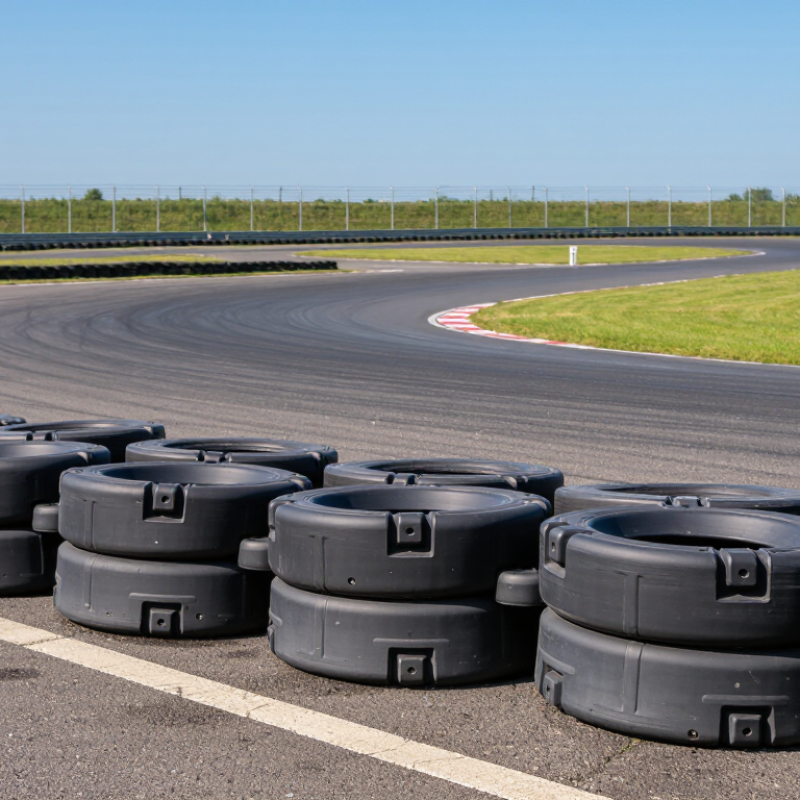
A rubber base kart track barrier is a modular safety unit placed beside a karting circuit. Its weighted rubber footing helps keep the barrier stable during contact. The upper body absorbs and redirects impact energy. Many systems use molded rubber, recycled tire material, or layered polymer components. The exact design varies. “Rubber base” is not one universal engineering standard.

In practical use, the barrier should reduce sudden deceleration and prevent kart wheels from climbing over its surface. FIA karting circuit guidance emphasizes controlled track protection and suitable impact-absorbing systems. The European Tyre and Rubber Manufacturers’ Association reported about 3.9 million tonnes of end-of-life tires in Europe during 2022. This supports recycled rubber use, but recycled content alone does not prove safety. Independent impact testing still matters.

Tips: Check barrier height, base width, connector strength, and drainage performance. Ask for test reports, material specifications, and temperature-resistance data. Inspect seams after repeated impacts. A barrier can look solid but move several centimeters on dusty asphalt. That detail is easy to miss. Suppliers should also explain replacement procedures and expected service life. In my view, a slightly imperfect fit is safer to identify early than to hide behind attractive product photos.

Key Features of Reliable Kart Track Barrier Systems

Reliable kart track barrier systems begin with controlled impact absorption. A rubber base should flex under contact, then return to shape without cracking. This reduces sudden rebound and protects both drivers and track equipment. The barrier surface must remain smooth, with no exposed bolts or sharp edges.

Stable installation matters just as much. Wide rubber feet help resist movement during repeated impacts. Interlocking sections keep the line continuous through corners and braking zones.

Strong connectors prevent gaps from opening. Bright, weather-resistant colors improve visibility under indoor lighting and changing outdoor conditions. Drainage channels are also useful after rain.

Details matter.

From practical track inspections, loose connectors often create larger problems than damaged panels. A reliable supplier should provide clear load guidance, installation instructions, and replacement parts. Materials should be tested across heat, cold, moisture, and frequent contact. Still, no barrier system stays perfect forever. Rubber can harden with age, and uneven flooring may reduce stability. This is easy to overlook. Regular checks should examine cracks, displaced bases, faded markings, and connector wear. Suppliers who document test methods and listen to operator feedback usually offer more dependable support. The best system is not simply heavy or thick. It should match the track layout, vehicle speed, maintenance routine, and available safety space.

How to Evaluate Chinese Rubber Base Barrier Suppliers

China Top Rubber Base Kart Track Barrier Supplier?

How to Evaluate Chinese Rubber Base Barrier Suppliers

Choosing a Chinese rubber base barrier supplier requires more than comparing online prices. Track safety depends on material quality, design accuracy, and consistent production.

Ask for technical drawings, rubber specifications, base dimensions, and impact test information. A reliable supplier should explain rubber hardness, rebound behavior, UV resistance, and performance in cold conditions. Request production samples before placing a large order. Check whether the sample has an even surface, stable weight, and cleanly molded edges.

Factory experience matters. I would inspect production equipment, quality records, storage areas, and packaging methods through a video audit or site visit. Photos can hide problems. Look for documented inspections during mixing, molding, curing, and final assembly. A supplier should also provide clear tolerances instead of vague claims.

Speak with recent customers about delivery accuracy and after-sales support. Ask how damaged units, color differences, or late shipments are handled. Warranty terms must be written and practical. One supplier may offer a lower quotation but use inconsistent recycled content. That risk is easy to underestimate. I once focused too heavily on unit price and overlooked packaging strength; several corners arrived scuffed. Now I compare total landed cost, replacement procedures, and inspection responsibilities. Small details matter.

Manufacturing Standards, Customization, and Quality Control

China Top Rubber Base Kart Track Barrier Supplier?

A reliable rubber base kart track barrier supplier starts with controlled manufacturing, not attractive photos. Experienced factories inspect rubber compound consistency, base weight, wall thickness, and anchor points. Each batch should have traceable records, including mixing time, molding temperature, and curing conditions. These details matter when barriers absorb repeated impacts beside tight corners.

Customization should match the circuit, not merely its color scheme. Suppliers can adjust barrier length, height, base shape, connection slots, and reflective markings. CAD drawings help confirm clearance near pit entries and safety run-off areas. Trial samples are essential. A small dimensional error can create gaps between connected units. That problem is easy to miss on a screen.

Quality control needs practical testing. Inspectors should check surface cracks, deformation, sharp edges, and unstable bases before shipment. Impact testing and temperature exposure can reveal weaknesses that normal visual checks cannot. Rubber may harden in cold storage or soften under strong heat. No design performs perfectly everywhere. Even a well-made barrier may shift on dusty concrete. Track operators should review installation, cleaning, and replacement procedures with the supplier. Honest communication is valuable here. A supplier that records defects, accepts revisions, and explains limitations is more dependable than one promising flawless performance.

China Top Rubber Base Kart Track Barrier Supplier? - Manufacturing Standards, Customization, and Quality Control
Evaluation Dimension Industry Reference or Typical Requirement Recommended Technical Data Quality-Control Method Procurement Consideration
Product Function Temporary impact protection for kart circuits, pit lanes, service areas, and spectator-exclusion zones. Use modular rubber-base barriers that can be linked into continuous rows and repositioned without permanent anchoring. Check interconnection strength, base stability, edge condition, and resistance to repeated handling. Confirm that the barrier is intended for karting environments rather than public-road crash containment.
Base Material Common constructions use molded rubber, recycled rubber, thermoplastic materials, or combinations of rubber and plastic. Request a declared material composition, recycled-content percentage where applicable, and material safety documentation. Review supplier material declarations and perform density, hardness, visual, and dimensional checks on production samples. Material consistency is important because hardness and density affect stability, durability, and impact response.
Rubber Hardness Shore A hardness is commonly used to characterize flexible rubber products. Specify an agreed Shore A range according to the intended track layout and barrier design; avoid accepting an undefined hardness value. Measure with a calibrated Shore A durometer at multiple points after conditioning the sample. Hardness alone does not prove impact performance; it should be evaluated with mass, geometry, and connection design.
Typical Dimensions Barrier dimensions vary by track layout, handling requirements, and available storage space. Define overall length, width, height, base footprint, unit weight, and allowable dimensional tolerance on the approved drawing. Use calibrated steel rules, calipers, weighing scales, and a first-article inspection report. Compact units improve handling, while a wider and heavier base generally improves resistance to movement.
Unit Weight Weight is a key factor in stability and manual handling. Set a target mass based on the required stability and the maximum safe handling capacity of the track crew. Weigh a defined sample quantity and record average weight, minimum weight, and maximum weight. Large weight variation may indicate inconsistent rubber density, voids, or incomplete molding.
Modular Connection Linked barrier systems help maintain alignment and reduce gaps between adjacent units. Specify connector type, connector material, allowable gap, connection direction, and replacement procedure. Inspect fit, pull resistance, alignment, and repeated assembly performance after multiple connection cycles. Connections should be secure during use but practical for rapid layout changes and maintenance.
Impact Resistance Rubber barriers should absorb and distribute low-to-moderate kart impacts without creating sharp fragments. Define an internal impact-test protocol using the expected kart mass, speed, impact angle, and barrier configuration. Record deformation, displacement, cracking, tearing, connector failure, and rebound behavior after testing. Do not describe a kart barrier as a certified vehicle-crash barrier unless the relevant test standard and report are available.
Abrasion Resistance Frequent contact with tires, concrete, asphalt, and handling equipment can wear the surface. Specify an abrasion-resistance requirement and define the permitted mass loss or visible wear level. Use a documented abrasion test method and compare results with the approved reference sample. High abrasion resistance can extend service life in high-traffic areas and reduce replacement frequency.
Weather Resistance Outdoor products may be exposed to sunlight, rain, temperature changes, and humidity. Request UV, ozone, temperature, and water-resistance requirements appropriate to the installation environment. Conduct accelerated aging where required, followed by visual inspection, hardness comparison, and crack assessment. Ask for recommended storage conditions and an inspection schedule for outdoor use.
Color and Visibility High-visibility colors can improve barrier recognition and track-side organization. Specify an approved color reference, color tolerance, surface finish, and optional reflective or high-visibility elements. Use visual comparison under controlled lighting or instrumental color measurement against an approved sample. Color consistency should be checked across batches, especially for safety-colored layouts and replacement units.
Customization Common options include dimensions, colors, logos, connector systems, drainage features, and handling openings. Approve a technical drawing covering geometry, materials, marking position, packaging, and tolerances before production. Perform first-article approval before mass production and retain the approved sample as a reference standard. Customization may affect tooling cost, minimum order quantity, lead time, replacement compatibility, and unit price.
Surface Finish Exposed surfaces should be free from sharp edges, loose flash, deep voids, and defects that may increase trip or handling risks. Define acceptable limits for molding flash, sink marks, cracks, bubbles, contamination, and surface distortion. Apply a 100% visual inspection with defect classification and photographic records for nonconforming items. Consistent finishing improves operator safety, appearance, and ease of cleaning.
Dimensional Tolerance Consistent dimensions are necessary for stable alignment and interchangeable replacement units. Use drawing-based tolerances for length, width, height, connector position, and base flatness. Inspect first articles and conduct periodic sampling during production using calibrated instruments. Critical connector and mating dimensions should receive tighter control than nonfunctional cosmetic areas.
Quality Management ISO 9001 is an internationally recognized framework for quality-management systems. Prefer suppliers that can provide a current, verifiable ISO 9001 certificate covering the relevant manufacturing site and scope. Verify certificate validity, certification scope, issuing body, and manufacturing-site details. Certification supports process control but does not replace product-specific testing or inspection.
Factory Process Control Key controls normally include incoming-material inspection, molding-process monitoring, trimming, assembly, and final inspection. Request documented work instructions, inspection plans, process parameters, and nonconformance procedures. Audit process records, equipment calibration, batch traceability, corrective actions, and operator training records. A documented process is more reliable than a visual quality claim without traceable records.
Batch Traceability Traceability helps identify the production date, material batch, mold, operator, and inspection result. Require batch or lot identification on packaging and retain production records for each shipment. Compare product markings, packing lists, inspection reports, and material-batch records. Traceability simplifies warranty evaluation, replacement matching, and corrective-action management.
Pre-Shipment Inspection Pre-shipment inspection should confirm quantity, specifications, appearance, packaging, and documentation. Use an approved inspection checklist with sampling levels and clearly defined acceptance criteria. Inspect dimensions, weight, color, connectors, surface defects, carton condition, and shipping marks. Independent or buyer-appointed inspection can reduce specification and quantity disputes.
Packaging Packaging should prevent deformation, contamination, moisture damage, and abrasion during storage and transport. Specify stacking limits, pallet requirements, protective materials, carton labels, and container-loading instructions. Check packaging strength, product count, moisture protection, labels, and loading photographs. Packaging design should balance protection, handling efficiency, storage space, and transport cost.
Documentation Typical technical documents include drawings, material declarations, inspection reports, care instructions, and installation guidance. Require an English technical data sheet, approved drawing, inspection record, packing list, and maintenance recommendations. Confirm that document revisions match the shipped product and purchase-order requirements. Clear documentation reduces installation errors and supports future repeat orders.
Maintenance and Service Life Service life depends on impact frequency, ultraviolet exposure, temperature, handling, and storage conditions. Establish routine inspections for cracks, cuts, deformation, connector damage, excessive wear, and loss of stability. Maintain inspection logs and remove units that no longer meet the approved condition criteria. Use a replaceable modular design so damaged sections can be changed without replacing the complete barrier line.
Compliance Statement Applicable requirements depend on the destination market, installation location, and intended use. Request a written compliance statement identifying the regulations, test methods, and limitations relevant to the product. Verify supporting reports and ensure that claims do not exceed the scope of the available evidence. Best practice: treat supplier claims as acceptable only when supported by traceable technical documentation.

Installation, Maintenance, and Supplier Selection Criteria

Installing a rubber base kart track barrier requires careful planning, not just physical strength. Measure the track edge and identify braking zones, blind corners, and likely impact points. Place barriers continuously, with aligned joints and minimal gaps. Secure each unit according to its design and the track surface. Loose barriers can move several centimeters after repeated impacts.

Maintenance should include weekly visual checks during busy seasons. Look for cracks, deformation, exposed fasteners, and water trapped beneath the rubber base. Clean rubber surfaces with mild detergent, then allow them to dry fully. Replace damaged sections before they affect nearby barriers. One practical mistake is checking only the front face. The rear connection and floor contact often show problems earlier.

Tips: Ask suppliers for material specifications, impact-test information, installation drawings, and inspection records. A dependable China-based supplier should explain rubber density, dimensions, tolerance, packaging, and replacement options clearly. Request samples before placing a large order. Compare production consistency, communication speed, customization ability, and after-sales support. Do not select solely by price. A cheaper barrier may require more frequent replacement. Confirm that the design suits local safety requirements and your track layout. A perfect drawing can still fail on uneven flooring, so test one section first and revise the plan when necessary.

Rubber Base Kart Track Barrier Supplier Selection Criteria

The chart presents a practical weighted evaluation model for selecting a rubber base kart track barrier supplier. Product safety and durability receive the highest weights, while installation support, maintenance requirements, compliance documentation, delivery capability, and total cost are also considered. A higher score indicates greater importance in the purchasing decision.

© 2025 Australian Premium Solar